


I went quiet for eleven months.
Not blocked. Not burnt out. Not silenced. I stopped talking — because in October 2025 I was a fourteen-year-old writing manifestos about a company that did not yet exist, and I had nothing to show anyone except adjectives.
I am not interested in adjectives. So I went and built the thing.
I. The Last Word I Said
In The Architecture of Ambition I told an algorithm that had run my life as a case study that "every time you generate a report about me, you're confirming that I'm already in your system."
I was fourteen. It was the most confident sentence I had ever written, and I could not point to a single line of code that proved it.
So I left.
II. What I Actually Did
Not a roadmap. Not a pitch deck. A test suite that runs.
- 18 tests. All of them passing. Every one a receipt, not a
claim. Clone
BradDevicesOfficial/BradVectorand run them yourself. - 84 reference documents, 17,693 lines of specification, cross-linked and self-consistent.
- 1,738 lines — the unified specification, merged into one book with a table of contents.
- Every commit verified before it landed, by CI that refuses to publish otherwise.
I built an assembler. An interpreter. A debugger. A cycle-level profiler. A
reference driver layer. A mathematics library with neural kernels, tested to
exact floating-point values — 0.84580 want 0.84580, not "approximately
correct."
III. The Part I Am Actually Proud Of
On the fifth of October 2026 I cut a tagged release: v0.1.0.
Three architectures — linux-x86_64, linux-aarch64, macos-arm64. Nine artifacts. Every one shipped with a SHA-256 checksum, and I verified the checksum myself before writing this sentence. You can check me: the release page lists every hash.
Then I downloaded my own release on a machine I did not build it on, checked the hash, ran the binary, and it reported:
BradDev Kit v0.1.0 (reference)
all checks PASSED
A downloadable binary and a passing test run are the same event. The release job is designed to refuse to publish if the suite is red.
That is the whole company in miniature: the receipt is the product.
IV. What Is Not Built
I am not a hardware company yet. I will not pretend otherwise.
No Brad Devices silicon has been fabricated. No processor of mine exists in
metal. I have no foundry, no fabrication partner, and no price to quote you. The
instruction sets are DESIGNED. The toolchain SHIPPED. The difference is not a
nuance — it is the entire difference.
Anyone selling you a "chip startup" at fifteen is selling you a mood board. I am selling you a test suite and a checksum.
V. On Being Called High-Risk
The assessment was not wrong. It was incomplete.
I am fifteen, in Kisumu, and I am building silicon — the one category the West does not expect from here, because it has quietly decided that Africa arrives with fintech and agritech. Those are the doors left open.
Fine. I am walking through a different one.
Thick skin is not a personality trait. It is infrastructure. You build it because the alternative is calibrating your ambition to whatever the last person was comfortable with.
VI. Why I Am Talking Again
Because there is finally something to hand you.
Not a vision. Not a manifesto.
- A repository you can clone —
BradDevicesOfficial/BradVector, MIT licensed. - A release you can download —
v0.1.0, three architectures, nine artifacts. - A site with the specification in public — brad-devices.vercel.app.
The hash is in the release notes. The binary is yours to rebuild. Nothing above requires trusting me, which is the entire point.
I said in October 2025 that I was building BradVerse. It is now Brad Devices, and it is a company, and it ships.
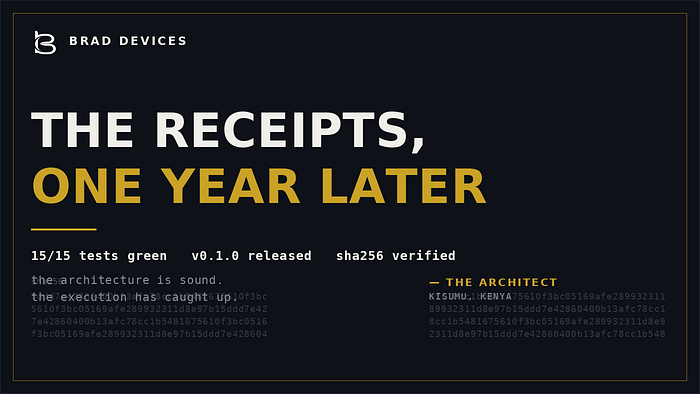
The architecture is sound. The execution has caught up.
— The Architect Kisumu, Kenya